

Rebar Coupler Manufacturer in India: Types, IS 16172:2023, Quality Checks & Buying Guide
Choosing the right rebar coupler manufacturer is an important decision for any construction project. The quality of a mechanical splice, compatibility with reinforcement bars and correct installation all contribute to the reliability of reinforced concrete structures.
As construction projects become larger and reinforcement arrangements become more complex, mechanical rebar splicing is an increasingly important alternative to conventional lap splicing. Rebar couplers connect reinforcement bars end-to-end, helping reduce reinforcement congestion and avoid unnecessary overlapping of steel.
Whether you are a contractor, builder, structural engineer, EPC company or procurement professional, understanding coupler types, manufacturing quality and applicable standards can help you select the right mechanical connection system.
This guide explains what to look for when choosing a rebar coupler manufacturer in India, the different types of couplers, their applications and the quality checks that matter before procurement.
What Is a Rebar Coupler?
A rebar coupler is a mechanical connector used to join two reinforcement bars, commonly known as TMT bars, end-to-end.
Unlike conventional lap splicing, where two bars overlap for a specified length, a mechanical coupler creates a connection through an engineered joining mechanism.
Depending on its design, the connection may use parallel threads, tapered threads, bolting, crimping, injection or other mechanical arrangements.
Rebar couplers are used in reinforced concrete structures where reinforcement continuity, installation space and construction requirements need to be considered.
Why Are Rebar Couplers Used in Modern Construction?
Conventional lap splicing remains a recognised reinforcement-joining method, but it can create challenges in heavily reinforced structural members.
Mechanical couplers offer an alternative in applications where overlapping reinforcement becomes difficult or inefficient.
Some important advantages include:
1. Reduced reinforcement congestion
Couplers can reduce the need for long overlapping bar arrangements, helping create more space within heavily reinforced sections.
2. Efficient use of reinforcement steel
Mechanical connections can reduce the additional reinforcement length required for lap splices. Actual savings depend on bar diameter, connection design and structural detailing.
3. Improved construction efficiency
When the correct coupler system and installation procedure are used, reinforcement connections can be completed efficiently on site.
4. Better concrete placement access
Reducing reinforcement congestion can help provide better access for concrete placement and compaction.
5. Useful for complex structural arrangements
Mechanical splicing can be particularly useful in columns, walls, foundations, precast elements and other applications where bar positioning or continuation is challenging.
The suitability of mechanical splicing must always be established through structural design requirements and project specifications.
Types of Rebar Couplers Available in India
A reliable rebar coupler manufacturer should understand that different construction applications require different connection systems. The correct selection depends on reinforcement diameter, steel grade, installation conditions and structural requirements.
1. Standard Threaded Rebar Coupler
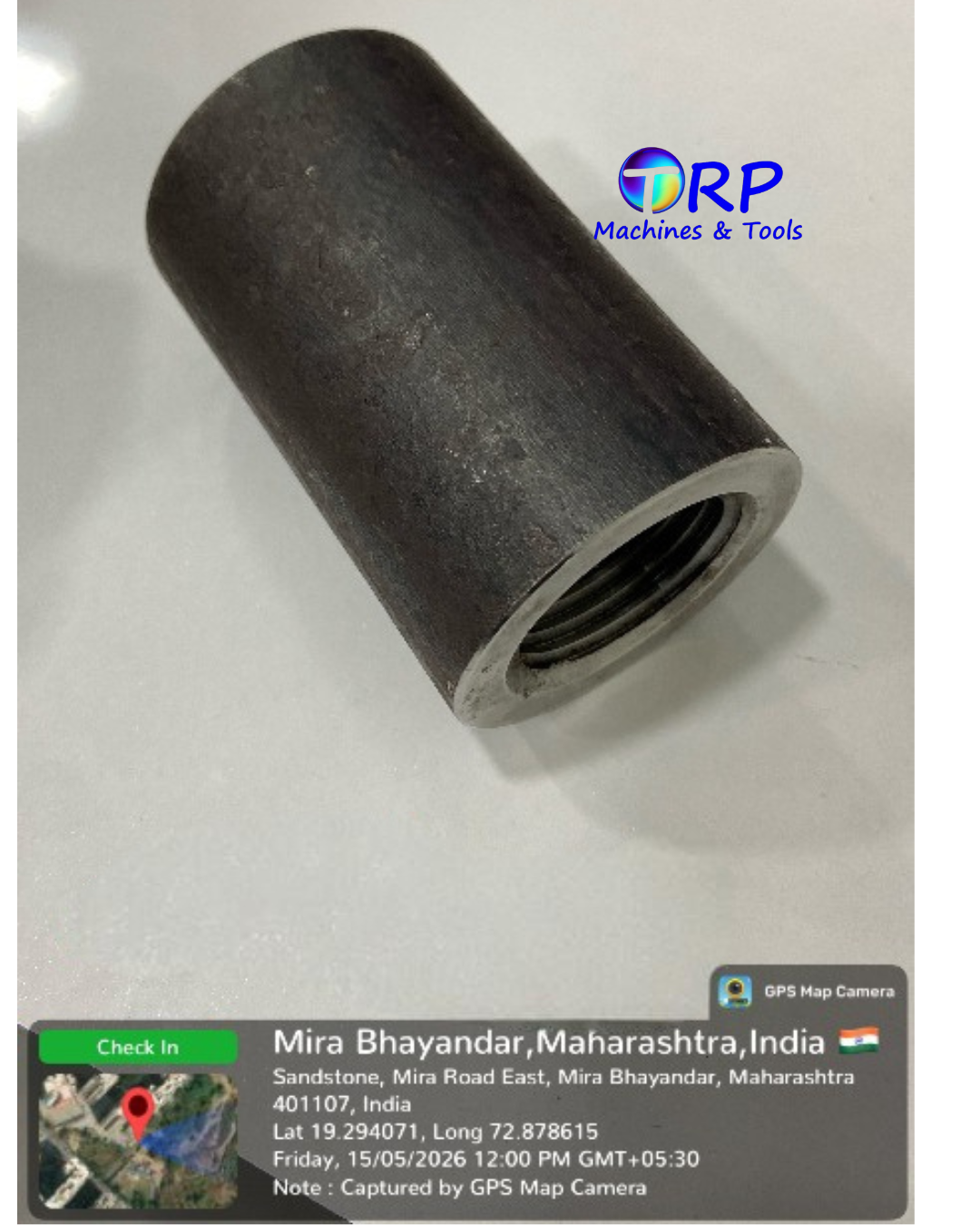
A threaded rebar coupler connects two reinforcement bars through matching threads prepared at their ends.
The coupler sleeve engages with the threaded portions of both bars to form a mechanical connection.
Common applications:
- Reinforced concrete columns
- Beams and structural members
- High-rise buildings
- General RCC construction
2. Parallel Thread Rebar Coupler
Parallel thread couplers use straight, parallel threads to connect reinforcement bars.
Depending on the approved system, bar ends may require preparation through threading and, in certain systems, cold forging or upsetting before threading.
The manufacturing and preparation process must maintain the required thread dimensions and connection performance.
3. MBT Rebar Coupler
An MBT-type mechanical coupler uses a bolted connection mechanism to join reinforcement bars.
It can be useful in situations where conventional bar-end threading is not suitable or where existing reinforcement needs to be connected.
Common applications:
- Reinforcement connections in existing structures
- Repair and extension work
- Situations with limited bar rotation
- Certain retrofit and construction applications
Installation must follow the manufacturer's specified bolt-tightening and inspection procedure.
4. Push-Fit Rebar Coupler
Push-fit couplers are designed to connect reinforcement bars through a push-in or locking arrangement, depending on the product design.
They can be considered where installation speed and restricted working space are important.
The connection mechanism and performance must be verified against the requirements of the particular project.
5. One-Touch Rebar Coupler
One-touch couplers are designed around a simplified connection arrangement intended to make reinforcement joining more convenient.
Their installation method, compatibility and load-transfer performance vary by design. Always check the manufacturer's technical documentation before selecting a system.
6. Reducer Rebar Coupler
A reducer coupler connects two reinforcement bars of different nominal diameters.
It is useful where structural detailing requires a transition between different reinforcement sizes.
7. Grouted Rebar Coupler
Grouted couplers use a specified grout material as part of the mechanical connection system.
They are used in suitable precast and structural applications where the connection design requires grouted engagement.
Important: Coupler names and commercial classifications can vary between manufacturers. Select the actual connection mechanism based on technical documentation, not just the product name.
IS 16172:2023: What Should Buyers Know?
When searching for a rebar coupler manufacturer in India, buyers should understand the relevant Indian Standard.
IS 16172:2023 – Reinforcement Couplers for Mechanical Splices of Steel Bars in Concrete – Specification is the Indian Standard covering reinforcement couplers for mechanical splices. It is the first revision of the standard.
The Bureau of Indian Standards identifies different coupler types, including:
- Parallel threaded couplers
- Upset parallel threaded couplers
- Tapered threaded couplers
- Crimped sleeves
- Injected sleeves
- Shear bolting systems
The standard also identifies coupler classes H and L.
For buyers, this means that selecting a coupler should involve more than checking its external dimensions. The connection type, performance class, reinforcement grade and nominal bar size must match the project requirements.
Before placing an order, ask the manufacturer for relevant test reports, technical specifications and applicable conformity or certification documents.
Do not assume that every product described as a rebar coupler is automatically certified or compliant with IS 16172:2023.
How Are Rebar Couplers Manufactured?
The manufacturing process depends on the coupler design, material specification and required dimensions.
A typical production workflow may involve the following stages:
1. Material Selection
The raw material is selected according to the required mechanical properties, dimensional requirements and product design.
Material traceability and incoming material inspection are important parts of quality assurance.
2. Cutting and Preparation
The selected material is cut into the required lengths. The dimensions must be controlled to maintain consistency during subsequent manufacturing operations.
3. Machining and Forming
The component is machined or formed according to its design.
For threaded couplers, internal threads must be produced with the specified diameter, pitch and profile.
4. Thread Inspection
Thread dimensions and engagement are important for threaded mechanical connections.
Suitable gauges and inspection methods should be used to verify the manufactured threads.
5. Finishing
The component receives the specified surface finish or protective treatment, where required.
6. Quality Inspection
Finished couplers should be checked for dimensional accuracy, visual defects and relevant performance requirements.
The exact production stages differ between threaded, bolted, crimped and grouted systems.
Quality Checks Before Buying Rebar Couplers
A low-cost coupler is not necessarily the right choice for a structural application. Buyers should evaluate technical suitability and quality documentation before making a purchase.
Consider these checks:
Quality parameterWhat to verifyMaterialMaterial specification and traceabilityDimensionsInternal diameter, length and tolerancesThread qualityThread pitch, profile and engagementBar compatibilityNominal bar diameter and gradeMechanical performanceRelevant tensile and other specified testsSurface finishCoating or finish as per requirementDocumentationTest reports and technical dataInstallationCorrect procedure and required tools
For project-specific procurement, request the applicable test documentation and confirm that the coupler system has been evaluated for the intended application.
Where Are Rebar Couplers Used?
Mechanical rebar couplers are used in several types of reinforced concrete construction.
Residential and commercial buildings: Columns, walls, foundations and heavily reinforced structural members.
High-rise construction: Reinforcement continuity in tall buildings where reinforcement congestion can become a practical challenge.
Bridges and flyovers: Structural reinforcement connections designed according to project-specific requirements.
Metro and railway infrastructure: Reinforced concrete structures, stations, viaducts and related infrastructure.
Tunnels and underground structures: Reinforcement connections in suitable tunnel and underground construction applications.
Industrial structures: Foundations, equipment-support structures and reinforced concrete industrial facilities.
Precast construction: Connections between precast reinforcement elements where an appropriate mechanical connection system is specified.
How to Choose the Right Rebar Coupler Manufacturer in India
Choosing a manufacturer should involve more than comparing quotations.
Here are seven important factors to consider:
1. Product range
Check whether the manufacturer can provide the connection type required for your project, such as threaded, MBT, push-fit, one-touch or reducer couplers.
2. Material and manufacturing information
Ask about material specifications, manufacturing processes and inspection procedures.
3. Technical documentation
Request dimensional drawings, technical specifications and relevant test reports.
4. Compatibility with reinforcement bars
Confirm the required bar diameter, steel grade and connection arrangement before ordering.
5. Installation guidance
A suitable manufacturer should be able to provide clear product-specific installation instructions.
6. Production and supply capability
For large construction projects, check order quantities, production lead times, consistency and dispatch arrangements.
7. Technical support
Responsive communication and technical assistance can help resolve product-selection and installation questions.
A manufacturer who understands both reinforcement connections and the associated processing requirements can be a useful technical resource during procurement.
Rebar Coupler Manufacturer and Supplier: Why the Difference Matters
A buyer may come across several businesses offering rebar couplers. However, it is useful to understand the difference between a manufacturer and a supplier.
A manufacturer is involved in producing the product and should be able to explain its manufacturing process, material selection and quality-control practices.
A supplier may provide products from one or more manufacturing sources.
For procurement teams, the important questions are:
- Who manufactures the coupler?
- What material and manufacturing specifications are followed?
- Are product dimensions and performance verified?
- Can the manufacturer provide relevant test documents?
- Is technical assistance available?
Understanding the product's manufacturing source helps buyers make a more informed procurement decision.
Rebar Couplers and Mechanical Splicing Solutions from TRP Machines & Tools
TRP Machines & Tools, based in Maharashtra, India, manufactures and supplies rebar couplers and mechanical reinforcement connection solutions for construction and infrastructure requirements.
The available product range includes:
- Rebar Couplers
- Threaded Rebar Couplers
- MBT Couplers
- One-Touch Rebar Couplers
- Push-Fit Rebar Couplers
- Reducer Rebar Couplers
- Other mechanical splicing solutions
The suitable connection system depends on reinforcement bar size, installation conditions and project specifications.
TRP also offers rebar processing equipment, including rebar threading machines and cold forging machines, supporting reinforcement preparation requirements.
For project enquiries, buyers can share their required bar diameters, steel grades, coupler type, quantity and application to help identify a suitable solution.
Explore the range: https://www.trpmachines.com/product/rebar-coupler
For product details and quotations: https://www.trpmachines.com/
Frequently Asked Questions About Rebar Couplers
1. What does a rebar coupler manufacturer do?
A rebar coupler manufacturer produces mechanical connectors used to join reinforcement bars. Manufacturing may involve material selection, cutting, machining, threading, finishing and quality inspection, depending on the coupler design.
2. Which is the relevant Indian Standard for rebar couplers?
IS 16172:2023 covers reinforcement couplers for mechanical splices of steel bars in concrete. Buyers should check the applicable requirements and project specifications.
3. What are the main types of rebar couplers?
Common connection systems include parallel threaded, upset parallel threaded, tapered threaded, MBT or shear-bolting, push-fit, one-touch, reducer and grouted couplers. The actual mechanism should be verified from the product documentation.
4. Are rebar couplers better than lap splicing?
Mechanical couplers can offer advantages such as reduced reinforcement congestion and reduced overlapping steel. However, the appropriate connection method depends on structural design, project specifications, installation conditions and cost considerations.
5. Can rebar couplers connect different bar diameters?
Yes. Reducer couplers are designed to connect reinforcement bars of different nominal diameters, subject to the specified product range and design requirements.
6. What should I check before purchasing a rebar coupler?
Check the bar diameter, steel grade, coupler type, material specification, dimensions, thread engagement where applicable, relevant test reports and installation instructions.
7. Where can I find a rebar coupler manufacturer in India?
Look for manufacturers who can provide clear product specifications, relevant quality documents, suitable coupler options and technical assistance. TRP Machines & Tools offers rebar couplers and mechanical reinforcement connection solutions for construction requirements.
Conclusion
Selecting the right rebar coupler manufacturer is an important part of planning reliable reinforcement connections. The correct coupler should match the reinforcement specifications, structural requirements and installation conditions of the project.
From threaded and MBT couplers to reducer and other mechanical splicing systems, each connection type serves a particular purpose.
By checking manufacturing information, dimensional accuracy, mechanical performance, relevant standards and technical documentation, construction professionals can make more informed procurement decisions.
Looking for rebar couplers for your next construction project? Connect with TRP Machines & Tools to discuss your reinforcement connection requirements and explore suitable mechanical splicing solutions.