

Construction Dust Control: How Fog Cannons Suppress Airborne Dust
Construction activities such as excavation, demolition, roadwork, drilling, crushing, and material handling release dust particles into the air. When left uncontrolled, this dust can spread beyond the work area, reduce visibility, affect surrounding environments, and create concerns for workers and nearby communities.
Effective construction dust control requires more than watering the ground. It involves understanding how dust becomes airborne, how particles move, and how suppression methods can reduce their dispersion.
How Is Construction Dust Generated?
Dust is released when dry materials are disturbed, broken, moved, or exposed to wind. Common sources include:
- Excavation, soil movement, and earthwork
- Concrete cutting, drilling, and demolition
- Sand, cement, and aggregate handling
- Movement of vehicles on unpaved roads
- Crushing, loading, and unloading materials
- Wind blowing over exposed soil and stockpiles
Smaller airborne particles may remain suspended longer, while larger particles generally settle faster. Wind and machinery can also lift settled dust back into the air, making dust control a continuous requirement on active sites.
How Does Water Mist Control Airborne Dust?
Water-based dust suppression works by reducing dust release and helping capture particles already suspended in the air.
When fine water droplets come into contact with airborne dust, particles may attach to the droplets, combine into larger aggregates, and settle under gravity. The effectiveness of this process depends on droplet size, particle characteristics, airflow, humidity, wind, and water delivery.
Unlike conventional watering, which is primarily used to wet soil, roads, and surfaces, mist-based suppression can target airborne dust directly.
How Does an Anti Smog Gun Work?
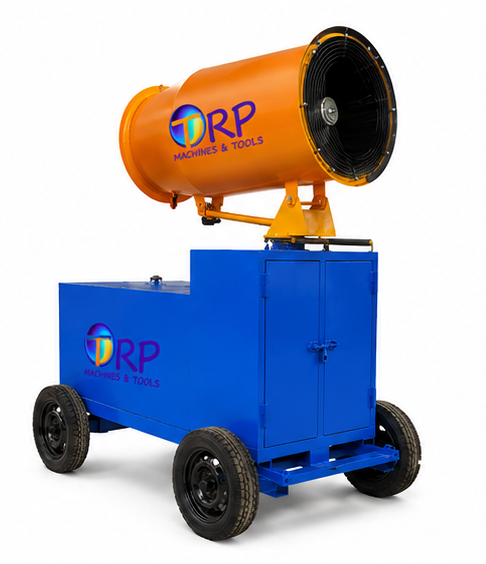
An anti smog gun, also called a fog cannon or dust suppression cannon, uses a pump, atomizing nozzles, and a high-volume fan to produce and project water mist.
- Water supply: Water is drawn from a suitable source.
- Pressurization: A pump supplies water to the atomizing nozzles.
- Atomization: Nozzles convert water into fine droplets.
- Projection: A powerful fan directs the mist toward the dust-generating zone.
- Dust interaction: Droplets interact with airborne particles, helping capture and suppress them.
- Settling: Water-associated particles may settle, reducing suspended dust.
Fog cannons are used in construction, demolition, roadwork, industrial yards, material-handling operations, and other dust-generating environments.
Anti Smog Gun 30 Meter vs 50 Meter: How to Choose?
The primary difference between a 30-metre and 50-metre anti smog gun is the intended mist projection distance, which influences machine positioning and the area that can be targeted.
30-Metre Anti Smog Gun
- Suitable for relatively localized dust suppression areas.
- Useful for smaller work zones or dust sources where the machine can be positioned closer.
- Practical where a moderate mist projection distance is sufficient.
- Can be considered for construction sites, demolition zones, material handling, and localized dust-control applications.
50-Metre Anti Smog Gun
- Designed for applications requiring a longer stated mist projection range.
- Useful when dust sources are farther from the machine's planned position.
- Can be considered for larger work areas, wider site layouts, and applications requiring greater reach.
- May help reduce the need to reposition equipment frequently, depending on site layout and conditions.
Which one should you choose? A 30M model may be sufficient when dust sources are close and localized. A 50M model may be more suitable when greater projection distance is required. Actual dust-control coverage is affected by wind, droplet characteristics, fan performance, water pressure, machine position, and site conditions. Projection distance alone does not guarantee uniform coverage.
Where Is Fog Cannon Dust Suppression Used?
- Construction sites: Excavation, earthmoving, foundation work, and material movement.
- Demolition projects: Breaking concrete, dismantling structures, and debris handling.
- Road construction: Soil movement, road preparation, and aggregate handling.
- Industrial facilities: Processing, loading, unloading, and material transfer.
- Waste and recycling sites: Dust from sorting, crushing, and handling debris.
- Mining and quarrying: Dust-generating stockpiles, loading areas, and material operations.
What to Consider Before Selecting a Dust Suppression Machine
Selecting an anti smog gun involves more than choosing its projection range. Consider the dust source, site area, wind direction, water availability, pump pressure, fan performance, power requirements, mounting configuration, and maintenance accessibility.
The machine should be positioned according to the dust-generating activity and surrounding conditions. Dust suppression equipment should also be supported by good housekeeping, surface watering where appropriate, material covering, and suitable monitoring.
Anti Smog Guns for Construction Dust Suppression
TRP Machines & Tools manufactures and supplies anti smog guns for construction, infrastructure, industrial, and dust-control applications. Available projection-range options, including 30-metre and 50-metre models, can be considered according to site requirements and the required mist reach.
Choosing the appropriate machine depends on the work area, dust source, operating conditions, and equipment configuration.
Frequently Asked Questions
What is an anti smog gun used for?
An anti smog gun is used to project fine water mist toward dust-generating areas to help suppress airborne particles in construction, demolition, industrial, and material-handling environments.
What is the difference between a 30M and 50M fog cannon?
A 30M model is intended for a shorter mist projection range, while a 50M model is intended for greater reach. The choice depends on site layout, dust source distance, and operating conditions.
Does a fog cannon remove PM10 and PM2.5?
Water mist can capture some airborne particulate matter, including PM10 and PM2.5, but the effectiveness varies with particle properties, droplet characteristics, environmental conditions, and equipment operation.
Is a fog cannon better than normal water spraying?
Fog cannons are useful for projecting mist toward airborne dust sources. Conventional water spraying is often suitable for wetting roads, soil, and surfaces. The appropriate method depends on the application, and both may be used together.
How do I choose the right spray range?
Assess the distance to the dust source, work area layout, wind, required positioning, and operating conditions. The stated projection range should be treated as a nominal equipment specification rather than a guaranteed effective dust-control radius.
Conclusion
Construction dust control requires a practical understanding of particle movement, dust generation, and suppression methods. Water mist helps control airborne dust by allowing droplets to interact with suspended particles and encouraging them to settle.
An anti smog gun provides a projected mist solution for dust-generating areas. Choosing between a 30-metre and 50-metre model depends primarily on the required reach, site layout, and application—not just the machine's range specification.
Effective dust suppression combines suitable equipment with proper positioning, maintenance, and site-management practices.