

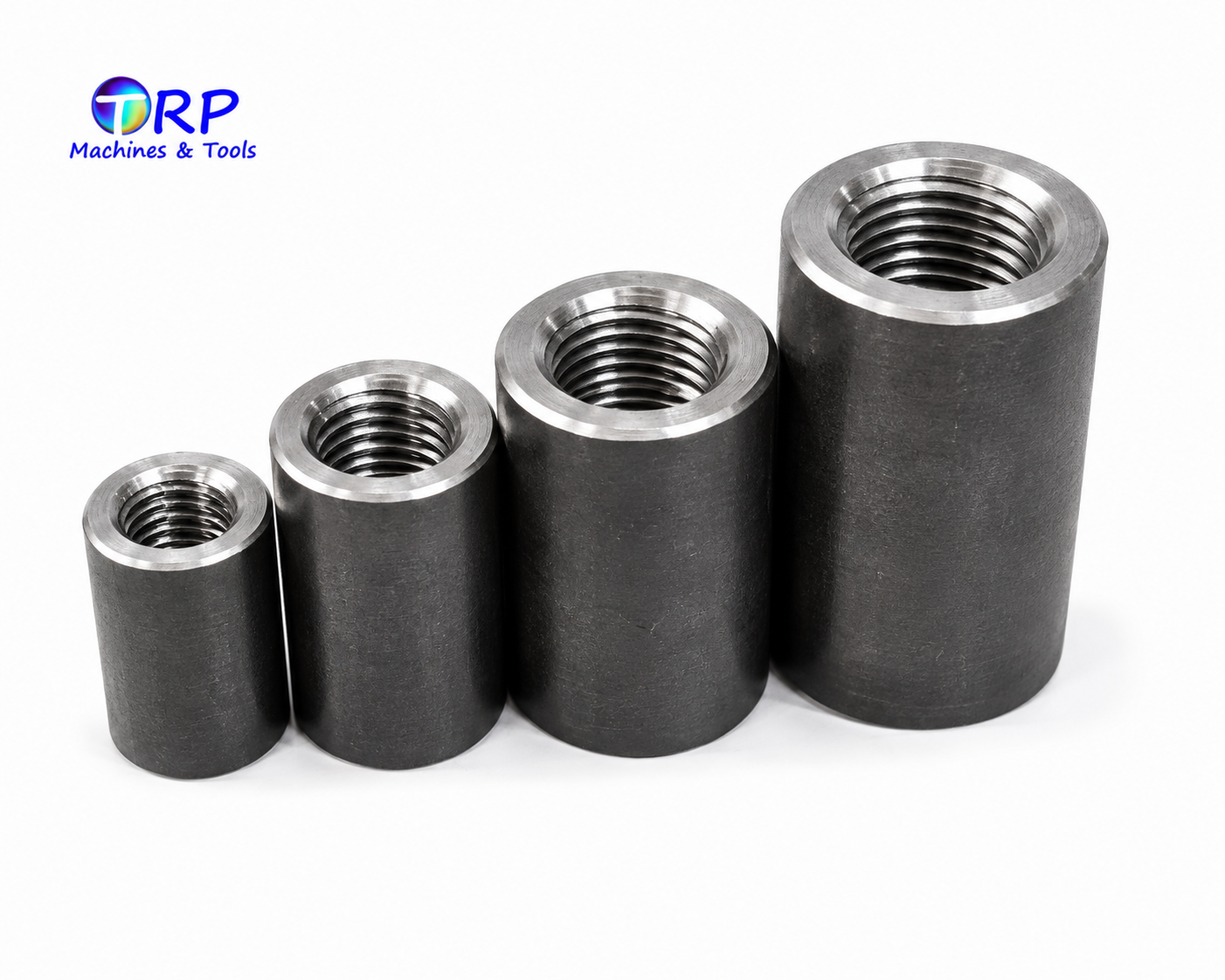
Rebar Coupler Manufacturer & Supplier in India
TRP Machines & Tools supplies Rebar Couplers for mechanical splicing of reinforcement bars used in RCC construction, infrastructure projects, high-rise buildings, industrial structures and reinforcement fabrication.
A rebar coupler is used to mechanically connect two reinforcement bars, providing an alternative to conventional lap splicing where a mechanical connection is specified by the project.
For contractors, structural engineers, builders, reinforcement fabricators and procurement teams, the important consideration is not simply the coupler price. The coupler must match the TMT bar diameter, connection method, application, required performance and project specification.
TRP Machines & Tools provides rebar coupling solutions for different reinforcement connection requirements, including threaded rebar couplers, MBT rebar couplers and One Touch rebar couplers.
What Is a Rebar Coupler?
A Rebar Coupler is a mechanical connector used to join two reinforcing steel bars end-to-end.
Instead of overlapping two bars over a specified lap length, a mechanical splice uses a coupler to transfer the required forces through the connection system.
BIS identifies IS 16172:2023 – Reinforcement Couplers for Mechanical Splices of Steel Bars in Concrete – Specification as the Indian Standard covering reinforcement couplers for mechanical splicing. The standard includes requirements relating to coupler classification, manufacture, testing, nominal sizes, performance and conformity.
Why Use Rebar Couplers in Construction?
Mechanical rebar splicing can be useful where conventional lap splicing creates practical or design challenges.
Rebar couplers are commonly considered for:
- Large-diameter reinforcement bars
- Congested reinforcement zones
- Column and beam reinforcement
- High-rise construction
- Bridges and infrastructure
- Industrial structures
- Foundations and heavy RCC construction
- Bar continuation between construction stages
- Applications where a mechanical splice is specified
BIS material notes that mechanical splicing can be advantageous for large-diameter bars and in situations where reducing congestion can help construction and concreting.
Rebar Coupler Types Available for Different Applications
Different projects require different connection methods. The correct coupler should therefore be selected according to the reinforcement and connection procedure.
1. Threaded Rebar Coupler
A Threaded Rebar Coupler connects reinforcement bars using compatible threads formed on the bar ends.
The typical process is:
TMT Bar → Bar-End Preparation → Threading → Coupler Installation → Connection Inspection
This type of system is suitable for applications where threaded mechanical splicing has been specified.
Benefits
- Mechanical end-to-end connection
- Suitable for controlled fabrication environments
- Useful for repetitive reinforcement connection work
- Supports organized threaded-bar production
TRP can provide compatible rebar processing solutions such as Rebar Cold Forging Machines and Rebar Threading Machines for applicable threaded connection systems.
2. MBT Rebar Coupler
An MBT Rebar Coupler is a mechanical fastening type of reinforcement coupler that can be used without conventional threading of the reinforcing bar.
This makes MBT-type systems useful for applications where bar rotation or conventional threading is difficult.
Key advantages
- No conventional bar threading
- No conventional bar rotation during installation
- Useful for restricted-access applications
- Suitable for certain retrofit and construction conditions
- Practical where mechanical fastening is preferred
The exact installation method and performance requirements depend on the selected coupler design and project specification.
3. One Touch Rebar Coupler
A One Touch Rebar Coupler provides a threadless approach to reinforcement connection for applicable systems.
Its installation concept can be useful where conventional threaded bar preparation is not preferred.
Potential benefits
- Threadless connection method
- Faster installation for suitable applications
- Useful where bar rotation is restricted
- Reduced dependence on conventional bar threading
- Practical for selected reinforcement connection requirements
The suitable model should be selected based on bar diameter, structural application, connection requirements and approved installation procedure.
Rebar Coupler Applications
Rebar couplers can be used across a wide range of reinforcement applications.
High-Rise Buildings
Mechanical splicing can be considered for reinforcement in columns, walls and heavily reinforced structural members where congestion needs to be managed.
Infrastructure Projects
Couplers are used in applicable mechanical-splice applications for bridges, tunnels, metro construction and other major infrastructure projects.
Industrial Structures
Factories, warehouses, power and process structures may use mechanical reinforcement connections where specified.
Foundations
Mechanical splicing can be useful in heavy reinforcement assemblies and areas with large-diameter bars.
RCC Columns and Beams
Where the structural design permits mechanical splicing, rebar couplers can provide end-to-end reinforcement connections.
Reinforcement Fabrication
Fabricators can integrate couplers with a controlled process involving cutting, preparation, threading and quality inspection.
Rebar Coupler vs Lap Splicing
The choice between a mechanical coupler and lap splicing depends on the structural design and project requirements.
Lap Splicing
- Uses overlapping reinforcement bars
- Can require significant lap length
- Can increase reinforcement congestion in some applications
- Commonly used conventional method
Mechanical Rebar Coupling
- Connects bars mechanically
- Can help reduce reinforcement overlap in applicable designs
- Can be useful for large-diameter reinforcement
- Can help manage congestion in suitable locations
- Requires an appropriate coupler and installation procedure
The decision should be made according to the project engineer's design, applicable standards and connection requirements.
Why Rebar Coupler Quality Matters
A coupler is not simply a steel sleeve.
It is part of a structural reinforcement connection system.
Important factors can include:
- Correct bar compatibility
- Coupler dimensions
- Thread quality where applicable
- Mechanical performance
- Slip performance
- Installation procedure
- Manufacturing quality
- Testing and conformity
- Site quality control
IS 16172:2023 covers different reinforcement coupler types, including parallel threaded, upset parallel threaded, tapered threaded, crimped sleeve, injected sleeve and shear bolting systems, and classifies couplers into Class H and Class L.
The BIS standard also specifies performance/testing provisions such as tensile, slip, cyclic tensile and fatigue testing as applicable to the coupler classification.
Rebar Coupler Sizes
Rebar couplers must be selected according to the nominal size of the reinforcement bar.
Common project requirements can include bars such as:
16 mm, 20 mm, 25 mm, 28 mm, 32 mm, 36 mm, 40 mm and larger sizes, depending on the selected coupler system and manufacturer configuration.
The exact available sizes should always be confirmed from the current technical specification of the selected product.
BIS indicates that nominal coupler sizes correspond to the nominal sizes of reinforcement bars covered by IS 1786.
Rebar Coupler Installation Process
The installation process depends on the coupler type.
For Threaded Rebar Couplers
Step 1 – Cut the Bar
Cut the TMT bar to the required length.
Step 2 – Prepare the Bar End
Where required by the selected system, prepare or enlarge the bar end.
Step 3 – Thread the Bar
Use the appropriate Rebar Threading Machine and tooling to create the specified thread.
Step 4 – Install the Coupler
Engage the threaded coupler according to the manufacturer's installation procedure.
Step 5 – Inspect the Connection
Check thread engagement, alignment, tightening and other applicable quality-control requirements.
For MBT, One Touch or other non-threaded systems, the installation process is different and should follow the specific manufacturer's procedure.
Rebar Coupler Manufacturing and Quality Considerations
When purchasing a rebar coupler, contractors and procurement teams should look beyond appearance and price.
Check:
- Raw material and manufacturing quality
- Dimensional consistency
- Bar-size compatibility
- Connection type
- Mechanical performance
- Applicable testing
- Batch identification
- Installation requirements
- Manufacturer documentation
- Project specification compliance
For projects requiring compliance with Indian standards, ask for the relevant test reports, conformity documentation and applicable licence/certification details rather than relying only on a sales statement.
Why Choose TRP Machines & Tools for Rebar Couplers?
TRP Machines & Tools supplies reinforcement coupling and rebar processing solutions for construction and infrastructure requirements.
Product-focused support includes:
- Rebar Couplers
- MBT Rebar Couplers
- One Touch Rebar Couplers
- Rebar Threading Machines
- Rebar Cold Forging Machines
- Other rebar processing equipment
This allows customers to evaluate the coupler and the bar-preparation process together, particularly for threaded reinforcement systems.
TRP supports:
Product Selection → Technical Discussion → Equipment/Connection Matching → Supply → Project Support
How to Select the Right Rebar Coupler
Before placing an order, provide the supplier with:
1. Rebar Diameter
What bar size will be connected?
2. Bar Grade
What reinforcement grade is being used?
3. Connection Type
Threaded, MBT, One Touch or another mechanical splice?
4. Application
Column, beam, slab, foundation, wall or infrastructure?
5. Installation Condition
Is there enough access and space for bar rotation and installation?
6. Project Specification
Is there a particular standard, test or approval requirement?
7. Quantity
How many couplers are required?
8. Testing Requirement
Are project-specific test reports or third-party testing required?
Providing these details helps the supplier recommend a more appropriate coupler instead of quoting a generic product.
Rebar Coupler Manufacturer & Supplier in India
TRP Machines & Tools supplies Rebar Couplers in India for contractors, builders, reinforcement fabricators, infrastructure developers, engineering companies and procurement teams.
Our focus is on matching the coupler type and reinforcement processing method to the customer's application.
Whether the requirement is for a Threaded Rebar Coupler, MBT Rebar Coupler, One Touch Rebar Coupler or a complete threaded rebar processing setup, the product should be selected according to the reinforcement diameter, connection method and project requirements.
Frequently Asked Questions
Who is a rebar coupler manufacturer and supplier in India?
TRP Machines & Tools is a Mumbai, Maharashtra-based supplier of rebar couplers and reinforcement processing equipment for construction and infrastructure applications.
What is a rebar coupler used for?
A rebar coupler is used to mechanically connect two reinforcement bars where a mechanical splice is specified.
What is the Indian Standard for rebar couplers?
IS 16172:2023 is the Indian Standard titled “Reinforcement Couplers for Mechanical Splices of Steel Bars in Concrete – Specification (First Revision).”
What types of reinforcement couplers are covered by IS 16172:2023?
The BIS implementation guidance identifies types including parallel threaded, upset parallel threaded, tapered threaded, crimped sleeve, injected sleeve and shear-bolting couplers.
What is an MBT rebar coupler?
An MBT-type rebar coupler uses mechanical fastening around the reinforcement bar and does not require conventional bar threading.
What is a One Touch rebar coupler?
A One Touch rebar coupler is a threadless mechanical connection solution for applicable reinforcement applications.
Are rebar couplers better than lap splicing?
Neither method is universally better. The appropriate connection should be selected according to structural design, reinforcement requirements, project conditions and applicable specifications.
Which rebar coupler should I buy?
The selection depends on the bar diameter, bar grade, connection type, project application, installation conditions and required compliance/testing.